Researchers put tiny stainless-steel mesh chambers under the skin of four rats, with one chamber receiving a copper peptide and the other receiving a control solution in each animal. By day 29, those chambers held 3.44 times as much collagen as the controls.
The peptide was GHK-Cu. Three amino acids bound to copper.
A chamber under a rat's skin sounds like an odd place to start a story about your face. But it lets researchers collect the tissue a body builds while repairing itself. In this experiment, GHK-Cu changed how much of that tissue accumulated.
That is a much more interesting starting point than another bottle promising a glow. How does something so small get living tissue to build more of its own structure?
Day 3 of 30 Peptides in 30 Days.
Three amino acids can change what a cell builds
The letters in GHK stand for glycine, histidine and lysine. They are amino acids, the building blocks of proteins, joined into a very short chain. Cu is the chemical symbol for copper, which the chain binds.
GHK was isolated from human blood plasma. This is a molecule found in us, with a chemistry researchers can study outside the body.
One of its most useful targets to understand is the fibroblast, a cell that makes the connective material surrounding other cells. In skin, that includes collagen, the protein that helps give tissue its strength.
In a 1988 experiment, François-Xavier Maquart and colleagues added GHK-Cu to fibroblast cultures. Collagen synthesis increased without an increase in cell number. The existing cells were making more collagen.
That distinction matters. GHK-Cu was influencing what the cells produced. It wasn't supplying enough material to build a sheet of collagen itself.
Think of the difference between delivering bricks to a building site and giving the crew a reason to start work. Protein supplies building material. A peptide can influence what cells do with the material available.
Copper has work of its own to do. The body uses it in enzymes involved in connective tissue and pigment production. In other words, a mineral we need in tiny quantities participates in processes you can eventually see in the mirror.
But making new collagen is only part of a repair job. What happens to the damaged material already there?
Rebuilding skin also means clearing old material
Return to the rat experiment. The researchers compared chambers receiving GHK-Cu with chambers receiving a buffered saline solution. At day 29, they measured the tissue inside.
Collagen content reached 344% of the control value. That means 3.44 times the control, or 244% more, not a 344% increase.
They also measured small fragments left by collagen breakdown. Those reached 188% of control. Both production and breakdown were active, with the balance favoring accumulation.
Why does that matter? Repair requires turnover: cells remove material while laying down new structure. The experiment gives us a view of that activity inside a living animal, rather than a claim based on how smooth a cream feels.
It does not give us a percentage to promise someone buying a face cream. It gives us a biological reason to test what happens when GHK-Cu reaches skin.
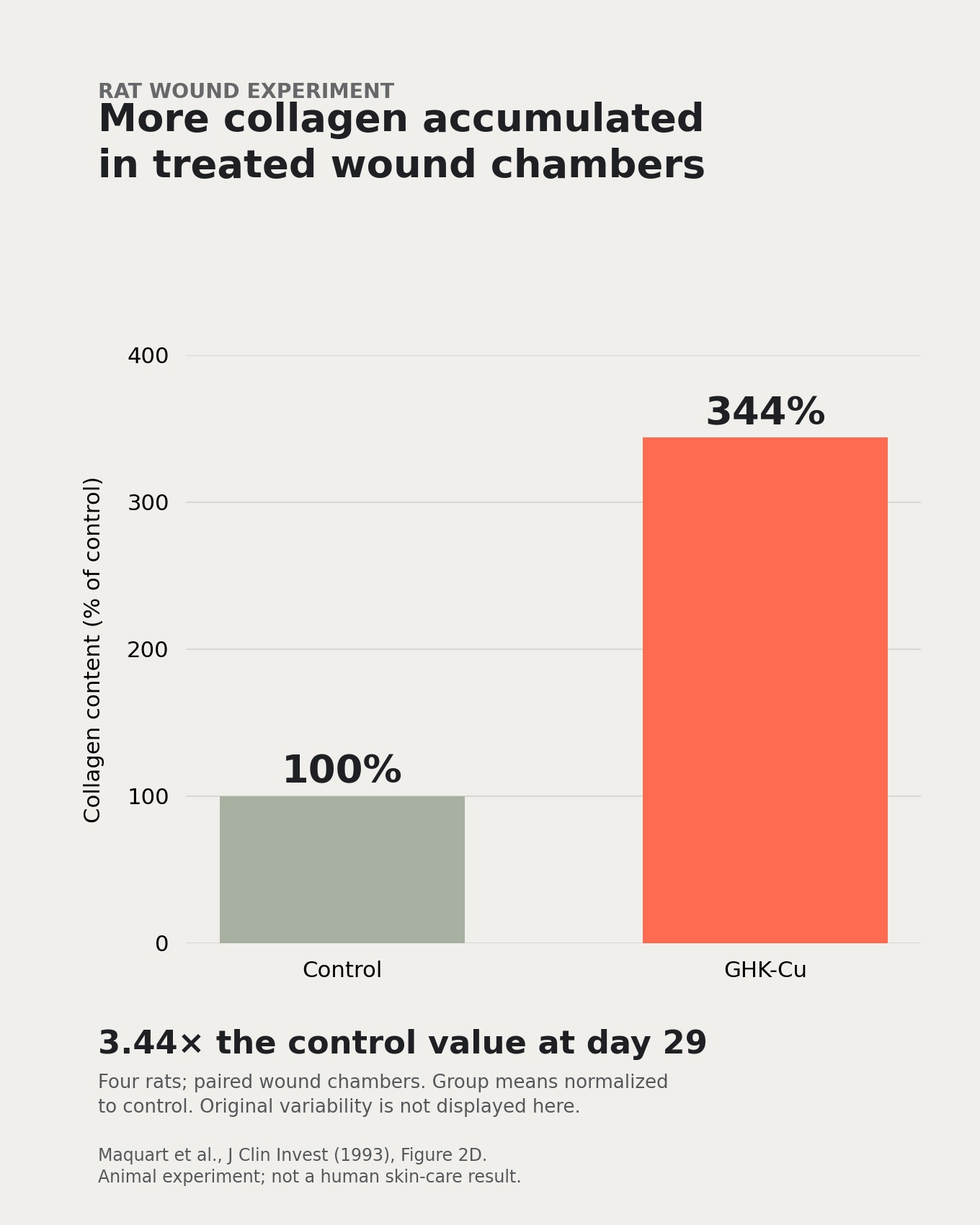
GHK-Cu-treated rat wound chambers contained 3.44 times the collagen of paired controls at day 29. Four rats; normalized group means. Individual variation is not displayed. Maquart et al., 1993, Figure 2D. This is an animal wound experiment, not a face-cream result.
My skin changed over about 60 days
I paired GHK-Cu with red light. Around 60 days, my skin looked brighter, the texture improved, and my fine lines and wrinkles improved.
That happened while I was rebuilding my health more broadly. I treated hypothyroidism, addressed gut problems and nutrient deficiencies, improved sleep, and raised my protein and glycine intake. The swelling in my face came down as my health improved. GHK-Cu then made the biggest visible change in the skin itself.
Those are my observations of the combination I used. I didn't run a one-ingredient experiment.
A controlled human study asks a narrower question. In 2006, researchers randomized people who had undergone laser resurfacing around the mouth to skin-care regimens with or without GHK-Cu. Thirteen people completed the study, with skin appearance assessed at 12 weeks.
Participants using GHK-Cu rated their improvement in overall skin quality more highly. Blinded evaluators and computer analysis did not find a significant advantage for redness resolution, and the groups did not differ objectively in wrinkles or overall skin quality.
So that particular regimen did not improve the objective outcomes after laser treatment. It is useful to know exactly what was tested: a peptide, in a formulation, on skin recovering from a procedure.
And the formulation is where the next experiment gets interesting. A repair signal has to reach the tissue that can respond to it.
The skin barrier changes the result
Your skin is built to keep things out. Its outermost layer, the stratum corneum, is a barrier a topical peptide has to negotiate.
In a 2015 laboratory experiment, researchers compared GHK-Cu delivery through intact human skin with delivery through skin pretreated using polymer microneedles. The tiny needles created channels through that barrier.
Over nine hours, 134 ± 12 nanomoles of peptide passed through the microneedle-treated skin. Almost none passed through the intact skin in the same setup.
A nanomole is a unit for counting a tiny amount of molecules. The useful finding is the contrast: changing access through the barrier changed how much peptide got across. This measured passage through a skin sample, not wrinkle reduction in people.
That is why microneedling interests me as a pairing. It changes the delivery problem. It also means the product and timing belong with the procedure plan; an ordinary cosmetic serum is not automatically made for freshly needled skin.
The formula carrying GHK-Cu is part of the intervention. A concentration on a label cannot tell the whole story about where the peptide ends up.
The same issue turns up when researchers try to get it to hair follicles.
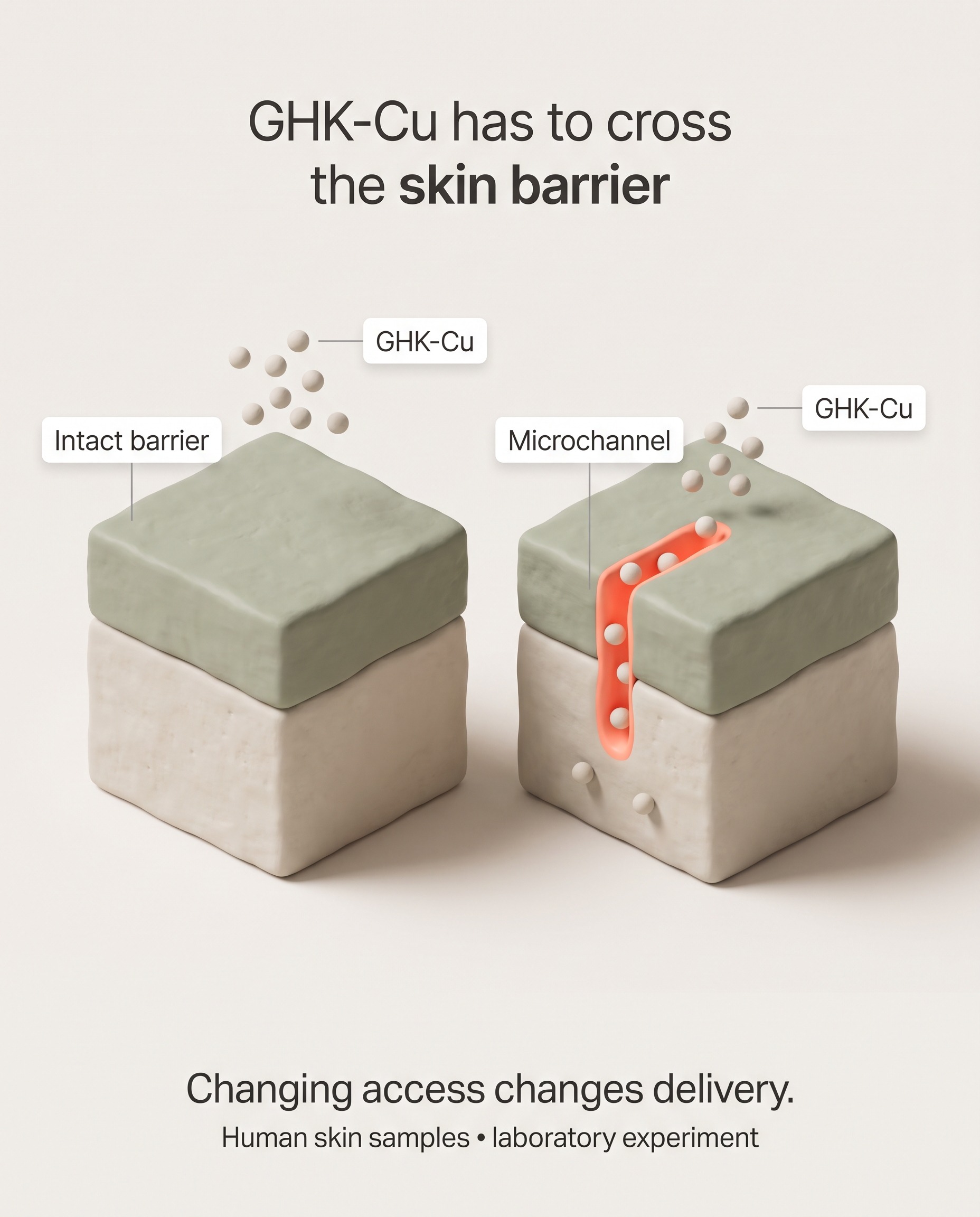
Original schematic of the delivery principle studied by Li et al., 2015. Microneedle pretreatment increased peptide passage through human skin samples in a laboratory experiment. Not a wrinkle-treatment result or procedural instructions; not to scale.
I turned gray pubic hair dark again in six weeks
Two years ago, I started getting a shocking amount of gray pubic hair. I blamed getting older and being stressed. My bloodwork showed something else: I was copper deficient.
Copper helps the body make melanin, the pigment that gives hair its color. One of the enzymes involved, tyrosinase, needs copper to work.
I started GHK-Cu. During the first month, my hair felt healthier and looked less dry. Around six weeks, I was seeing a lot less gray. Repeat bloodwork showed my copper had moved from deficient into the optimal range.
That result was impossible for me to ignore. I had treated a visible change as an inevitable part of aging, then found a missing nutrient involved in the process that makes pigment.
I was changing several things about my health in that period, so I can't isolate GHK-Cu's contribution. The six-week result is my experience; copper's role in pigment is the mechanism that makes the story worth investigating.
Hair color and hair growth are different outcomes. For the growth question, there is another experiment worth knowing about.
Liu and colleagues developed a formulation for carrying GHK-Cu through skin, published online in 2023 in Bioactive Materials. In pig-skin laboratory tests, their microemulsion, a mixture designed to carry the peptide, produced about 3.18 times the passage through skin of the buffered-solution comparison.
They then tested the delivery system on mice whose back hair had been removed. The formulation promoted hair regrowth. That is a mouse hair-growth result, separate from my experience with pigment.
The connection to skin care is the delivery problem: researchers changed the carrier and got different access to the tissue. There is useful engineering to do around the peptide itself.
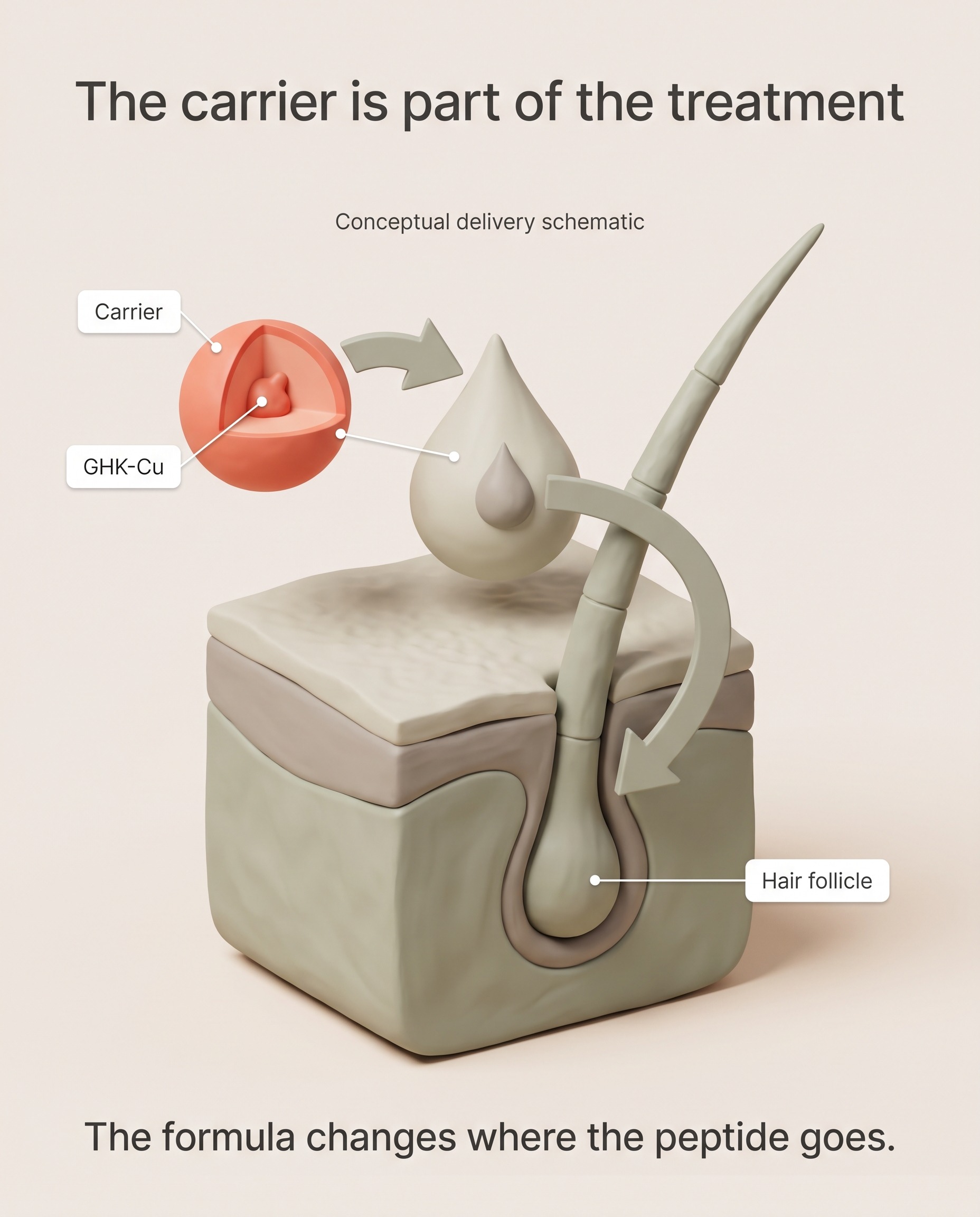
Original conceptual schematic, not a measured image or exact molecular structure. Liu et al. tested skin passage in pig skin and hair regrowth in mice. The carrier, follicle and arrow illustrate the delivery problem; they do not depict human regrowth.
Give your skin routine a result to aim for
The practical lesson is to choose what you want GHK-Cu to do before choosing a product.
Facial texture, scalp density and hair color are different goals. They need different observations. A photo of smoother cheeks cannot tell you whether a scalp treatment changed hair density, and a darker hair does not tell you how much collagen your skin made.
For a skin routine, I would photograph the same areas under the same lighting and track texture, fine lines and skin tone. Keep the distance and angle consistent. Put the dates beside the photos so the comparison doesn't depend on memory.
Write down the product and the routine, too. Record its stated active ingredient, strength, intended application and anything else you changed. My skin experience included red light; leaving that out would turn a useful account into a different story.
If you change the cream, start a new treatment and change the lighting between photos, you have made your own results harder to interpret. Give the comparison a chance to mean something.
A facial topical, a scalp formulation and an injection deliver the peptide differently. Choose the route for the goal and the product's intended use. An injection does not inherit the results of a topical experiment simply because both labels say GHK-Cu.
The opportunity that keeps me interested is concrete: improve how a peptide with measurable repair activity reaches the tissue we want to change. The delivery studies show researchers working on exactly that problem.
You want the repair biology and the delivery to work together. That is the question I would bring to a GHK-Cu routine.
Next: KPV, three amino acids with a very different inflammation story.
References
1. Maquart FX et al. (1988). Stimulation of collagen synthesis in fibroblast cultures by GHK-Cu. FEBS Letters.
2. Maquart FX et al. (1993). In vivo stimulation of connective tissue accumulation in rat experimental wounds. Journal of Clinical Investigation. Figure 2 and experimental design.
3. Miller TR et al. (2006). Effects of topical copper tripeptide complex on CO2 laser-resurfaced skin. Archives of Facial Plastic Surgery.
4. Li H et al. (2015). Microneedle-mediated delivery of copper peptide through skin. Pharmaceutical Research.
5. Liu T et al. (2023; 2024 collection). Thermodynamically stable ionic liquid microemulsions pioneer pathways for topical delivery and peptide application. Bioactive Materials. Figures 4 and 5.
6. NIH Office of Dietary Supplements. Copper: Health Professional Fact Sheet.
7. Spritz RA et al. (1997). Mutational analysis of copper binding by human tyrosinase. Human Molecular Genetics.
Choose a GHK-Cu routine for your skin or hair goal.
Compare forms and pairings, then use the photo and tracking checklist to see whether your routine is making the change you want.
For entertainment and education only. Not medical advice. Talk to your doctor before starting anything.